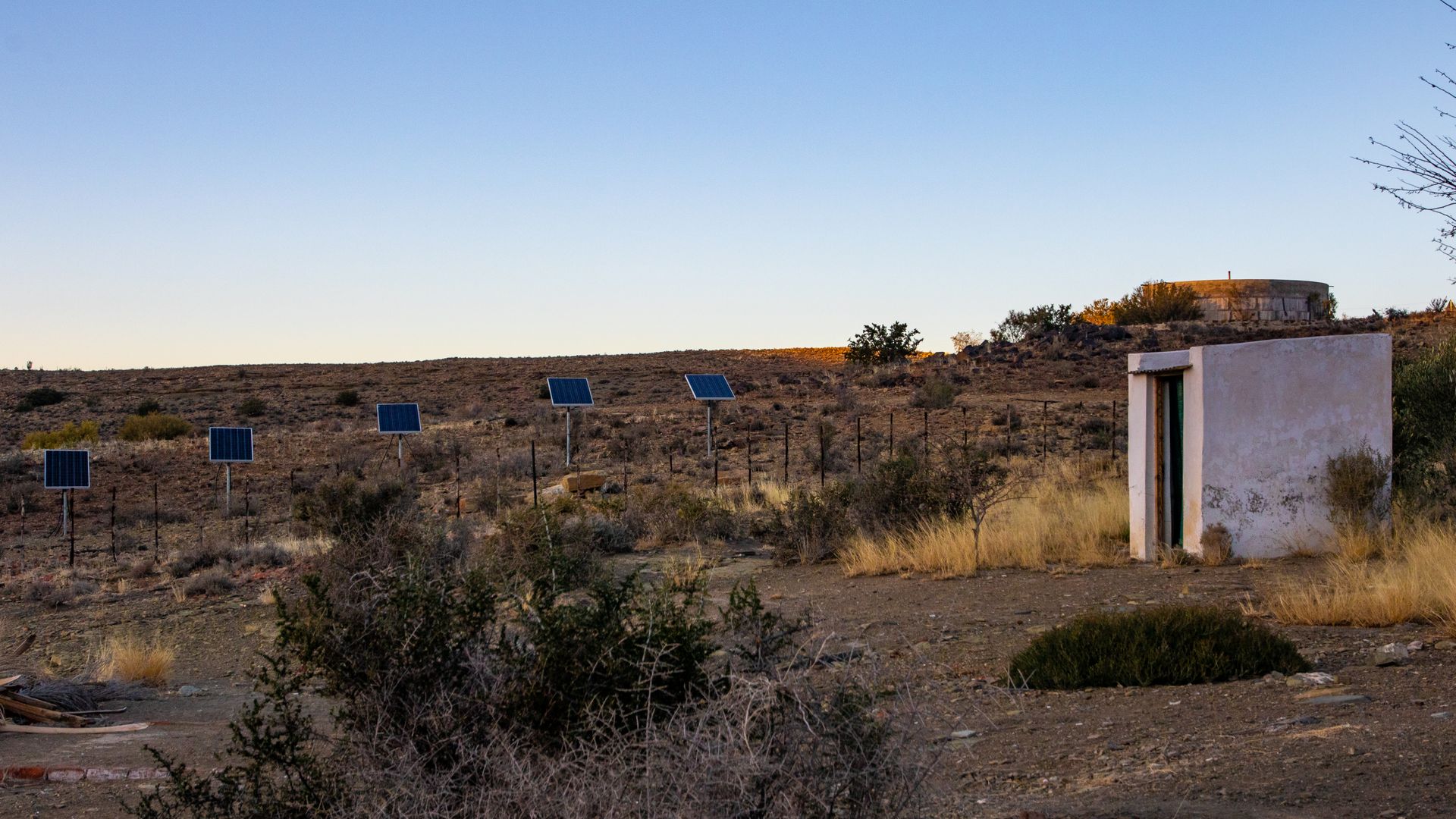
Cyprus · off-grid solar
Off-grid solar in Cyprus.Compare several quotes at once.
Off grid solar in Cyprus is a reliability engineering problem: with no network behind it, the system must carry the site's load through the worst design week, not the average one. Sizing, topology and generator integration all follow from that single constraint.
- Technical specification first
- Regulatory sequence documented
- Installer credentials verified
Off-grid solar companies in Cyprus
A different problem from grid-tied solar
Grid-tied design optimises economics against a network that absorbs surplus and covers deficit. Standalone design has no such counterparty: the system alone carries the site through every hour of the year, including the December week of low cloud that contributes nothing to an annual irradiance average but defines whether the lights stay on. That inversion — designing for the worst credible period rather than the mean — runs through every sizing decision in off-grid work, and it is why methods carried over casually from grid-tied practice produce standalone systems that fail in exactly the weeks they were bought for.
Cyprus is, by the standards of this discipline, a favourable theatre: among the highest solar irradiance in the EU, mild winters by continental comparison, and a short gap between winter and summer day length relative to northern latitudes. Favourable is not forgiving. Consecutive overcast days occur in every Cypriot winter, summer heat depresses both module output and battery life, and the remote sites where off-grid systems belong are precisely the sites where a service visit is slow and a failure expensive.
Where standalone design genuinely applies
The honest screening question comes before any engineering: is the grid truly out of reach? Standalone supply is the correct answer where no connection exists and extending one is prohibitive against the standalone alternative — the remote agricultural holding, the mountain dwelling far from the nearest network branch, pumping and telemetry installations scattered across rangeland. It is the wrong answer where a connection exists or is economically extendable, because a grid-tied system with storage delivers the same daytime economics while retaining the network as the cheapest and most reliable backup ever offered to a system designer; the household economics of that arrangement are worked through in the residential solar guide. Disconnecting a connectable site as a statement of independence purchases redundancy engineering that the grid was already providing.
A related screening question concerns criticality. A weekend property that tolerates an occasional dark evening, a dwelling that cannot, and a refrigerated agricultural store that must never lose cooling are three different reliability specifications, and honest classification at the outset sets the autonomy and redundancy budget for everything that follows.
The load audit is the foundation
Every credible standalone design begins with a load audit: an itemised schedule of every electrical load on the site, its power draw, its daily duty cycle and its seasonality, aggregated into daily energy demand per season. The audit does double duty. It produces the demand figure the system is sized against, and it exposes the loads that should not be electrical at all — because in standalone design, demand-side decisions are frequently cheaper than the supply-side capacity they displace.
The classic Cypriot examples: water heating belongs to solar thermal, not to the battery bank; cooking to bottled gas; space heating, where needed in the hills, to fuels rather than resistive elements. Refrigeration deserves efficient, well-specified equipment because it runs continuously and dominates the base load. Pumping — the anchor load of agricultural sites — is time flexible, and scheduling it into generation hours through storage tanks rather than batteries stores the water, not the electricity: usually the cheapest storage on the property. Surge behaviour also surfaces in the audit: motors draw multiples of their running power at start, and the inverter must be rated for the coincident surge case, not the placid average.
Sizing: winter design point plus autonomy
With seasonal demand established, sizing proceeds against the worst season. Winter combines shorter days, lower sun angles and the year's weakest irradiance with, for occupied dwellings, the year's longest evenings of consumption; it is the design point. An array sized to satisfy summer demand is a system that fails from November to February.
The array is therefore sized so that winter generation meets winter demand with margin — margin for soiling, for degradation over the system's life, and for the optimism endemic to load audits. Mounting angle follows the same logic: standalone arrays are commonly tilted more steeply than grid-tied arrays at the same latitude, sacrificing summer yield the system does not need in favour of the winter yield it lives on. Summer over-generation is the accepted by-product; unlike a grid-tied system, there is nowhere for the surplus to go, and the charge control equipment curtails it as a matter of routine.
Storage sizing turns on the autonomy decision: the number of consecutive sunless days the battery bank alone must carry. The parameter is chosen, not computed — chosen against the site's criticality classification and the local weather record of consecutive overcast days. Deeper autonomy buys reliability with capital; the curve steepens quickly, which is why the statistical tail is better covered by a generator than by batteries, as taken up below. Usable capacity is what the sizing must count — the fraction of nameplate capacity the chosen chemistry can cycle repeatedly without unacceptable degradation — and thermal derating deserves inclusion in both directions, since Cypriot equipment rooms run hot in summer and mountain sites run genuinely cold on winter nights.
Topology for standalone systems
Standalone architecture differs structurally from grid-tied practice. The central component is not a grid-following inverter but a battery inverter (or inverter-charger) that forms the site's AC network itself — setting voltage and frequency for the premises, where a grid-tied unit merely synchronises to a network the utility maintains. Around that grid-forming core, array power arrives by one of two routes: DC-coupled, through solar charge controllers feeding the battery bus directly; or AC-coupled, through grid-tied-style inverters that synchronise to the AC network the battery inverter creates.
DC coupling is the traditional standalone pattern — robust, efficient into storage, and well matched to sites where most energy passes through the battery. AC coupling suits larger daytime loads served directly by the array and reuses mature grid-tied hardware, at the cost of a control dependency: the AC-coupled generation must be curtailable by the grid-forming inverter when the batteries are full, a coordination requirement that must be verified across the specific equipment combination, not assumed from brochures. Hybrid arrangements combining both routes are common on larger sites, and modern integrated machines blur the categories — which makes the specification question concrete rather than stylistic: which unit forms the grid, which units follow it, and how is surplus curtailed when storage is full?
Three-phase standalone supply, where large motors demand it, multiplies rather than complicates: clustered single-phase inverters or native three-phase machines form the network, with phase balance and the surge behaviour of three-phase motor starts driving the ratings.
The generator: covering the tail
Sizing batteries for the rarest weather is the least economic decision in standalone design, which is why serious installations integrate a backup generator instead. Its role is statistical: solar and storage carry the overwhelming majority of the year, and the generator covers the residual tail — the prolonged overcast spell beyond the autonomy allowance, the seasonal demand spike, the maintenance interval when the bank is deliberately rested.
Integration quality separates a designed system from an improvisation. The generator should start automatically on state-of-charge or voltage criteria, charge the bank through the inverter-charger or dedicated charging equipment at a rate the bank accepts, run at efficient loading for a bounded period, and stop — unattended, logged, and tested. Runtime records then become a design feedback signal: a generator accumulating hours in an ordinary winter is reporting an undersized array or bank, and the log says so long before the fuel bills do.
Operations, monitoring and the long view
A standalone system is a small utility, and it needs a utility's habits. Monitoring should record state of charge, generation, consumption, battery temperature and generator runtime, with remote visibility wherever connectivity allows — the sites in question are, by definition, the ones nobody passes daily. Routine attention follows the same rhythms as any Cypriot solar asset — soiling after dust episodes, terminal and connection inspection, ventilation of equipment spaces — with the added discipline that there is no network to mask a developing fault.
Two contractual notes close the loop. Warranties on standalone equipment carry operating-condition terms — temperature, cycling depth, charge regime — that the design documentation should demonstrably respect, since a remote site's claim rests entirely on its logs. And where any plausible future grid connection exists, equipment choices made now — inverters with grid-interactive certification, wiring executed and certified to connectable standards — preserve an option that costs little at design time and a great deal to retrofit. The grid operator's application process, not the hardware, governs any later connection; a standalone system built as though it might one day apply is the cheaper of the two ways to find that out.
Common questions
- When does off-grid solar make sense in Cyprus?
- Where a grid connection is unavailable or its extension cost exceeds the standalone system's cost over its life — remote agricultural holdings, isolated dwellings, telemetry and pumping sites far from the network. Where a connection exists or is affordable, a grid-tied system with storage almost always outperforms standalone design, because the grid remains the cheapest backup available.
- How is an off-grid solar system sized?
- From a load audit forwards: every load itemised with its power draw, duty cycle and seasonality, aggregated into daily energy demand. The design point is then the worst season — winter, with shorter days and weaker irradiance — plus an autonomy allowance carrying the site through consecutive overcast days. Array, storage and conversion equipment are sized against that case, never the summer average.
- Does an off-grid system need a backup generator?
- Most serious installations include one. Sizing storage to cover the rarest prolonged overcast spells purely with batteries is uneconomic, so a generator covers the statistical tail: it runs briefly, charges the bank through the system's charging equipment, and lets the solar and storage handle the overwhelming majority of the year. Automatic start control and correct integration are part of the design.
- What is days of autonomy in off-grid design?
- The period a fully charged battery bank can carry the site's design load with no solar input at all. It is the central reliability parameter in standalone sizing: more autonomy means a larger, costlier bank but fewer generator hours and greater tolerance of poor weather. The figure is chosen against the site's criticality and the local pattern of consecutive sunless days.
- Can an off-grid system be connected to the grid later?
- Physically the assets can often be reused, but not by simply attaching a cable. Grid connection requires an application to the grid operator, inverters certified and configured for grid-interactive operation, and recertification of the installation. Off-grid inverters without grid-interactive approval must be replaced or supplemented, so a plausible future connection is worth reflecting in equipment choices.
01Before specification
Off-grid solar performs to its design,not to its datasheet.
Four specification checks that decide whether a commercial system delivers what the model promised.
Start from the load profile
Self-consumption is set by when the load occurs, not by its annual total. Half-hourly data beats any rule of thumb.
Load first
Settle the export limit early
The EAC connection agreement constrains the design more than the roof does. Specify after it is agreed, not before.
Grid first
Size storage on the deficit
Batteries cover the gap between generation and load. Sizing them on generation alone buys capacity that never cycles.
Deficit-sized
Demand a performance ratio
A specified PR makes underperformance measurable and contractual. Without one, “working” is whatever the installer says it is.
Contractual

Need off-grid solar?One form. Up to five quotes.
Describe the installation and we will gather quotes from suppliers who specify before they price.