Electrical work
Certified solar installers in Cyprus — the questions that come up most
What certification actually means for a solar installer in Cyprus: which licence signs the work, what ETEK covers, and which documents belong in a quote.
7 min read

Christos covers electrical work, battery storage and the off-grid and commercial systems that sit on top of them. He tracks EAC grid connection requirements and export limits, which constrain more Cypriot installations than roof area ever does.
Published
There is no single badge in Cyprus that makes a company a certified solar installer. What exists instead is a stack of separate credentials, each covering a different part of the job: a company registration, an electrical contractor's licence held by a named person, professional registration with ETEK where design work is involved, insurance in force across the installation period, and manufacturer accreditation that decides how a warranty is honoured. A buyer comparing quotes is comparing those five things, not a logo.
The ten questions we get most
- Is there one certificate that makes an installer certified?
- Who actually signs off the electrical installation?
- What does ETEK registration cover, and which jobs need it?
- Does the installer or the owner submit the connection application?
- Does manufacturer accreditation matter, or is it marketing?
- Can the company itself be checked before signing anything?
- What insurance should be in force, and for how long?
- Who applies for the residential grant, and when?
- What documents should exist at handover?
- Does any of this change for a commercial or agricultural system?
Short answers
One certificate? No. The credential that carries legal weight at the end of the job is the electrical installation certificate. Everything else — trade associations, manufacturer badges, training certificates — sits alongside it.
Who signs. A licensed electrical contractor, named individually rather than as a company. A new or altered installation is energised against that signed certificate, so if nobody in the contracting chain can sign it, the problem surfaces on the day the system is meant to be switched on.
ETEK. ETEK is the statutory chamber for engineering professions in Cyprus. Where the work carries a design element — three-phase systems, ground-mounted arrays, roof loading that has to be assessed, commercial and agricultural installations — the design side sits with a professional registered with the chamber. A domestic array on an existing pitched roof usually does not.
The connection application. Normally the installer submits it to the Electricity Authority of Cyprus before commissioning, and it typically runs to around 45 days. Normally is not always: where the contract does not name the responsible party, that party turns out to be the owner, and late.
Manufacturer accreditation. It matters for one reason: several inverter and battery manufacturers honour their warranty only through an accredited installing company. It is a question about the route to the warranty, not about competence.
Checking the company. Registration under Companies Law Cap. 113 is publicly checkable at the Registrar of Companies, which returns the legal name and incorporation date. A quote issued in a trading name that matches no registered entity is worth resolving before a deposit moves.
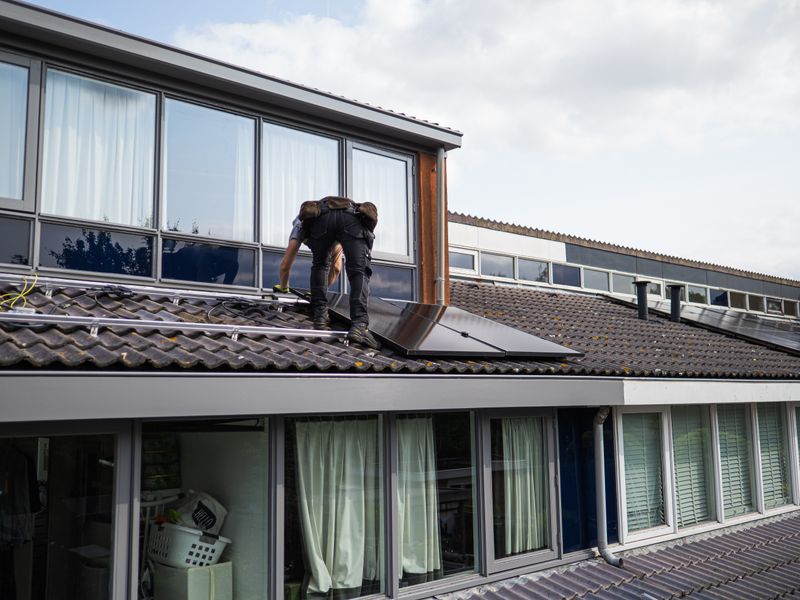
Insurance. Public liability, dates visible, in force across the installation period rather than at the date the certificate was issued. Work on a roof above an occupied property is the case that makes this concrete.
The grant. The residential scheme is directed at grid-connected PV on a primary residence and is applied for before installation begins. Work already started sits outside it, and this is the one step that cannot be recovered afterwards.
Handover documents. The commissioning record with measured values, the electrical installation certificate, the as-built single line diagram and labelling schedule, warranty documentation separated by type, and monitoring access in the owner's name.
Commercial and agricultural. The same credential stack, with the design element engaged more often, three-phase connection work in scope, and export limits and load assessment more likely in the connection process.
Where the answer depends
Three variables move nearly every answer above: system size, property type, and whether anything structural or protected is being touched.
System size and phase. A single-phase domestic array on an existing pitched roof is the plainest case in the credential stack. A three-phase system changes the protection design, the connection application and usually the professional who signs the design. Storage adds a layer: a hybrid inverter brings a DC-coupled battery port and a backup output carrying selected circuits, and the backed-up sub-board is a distribution board redesign inside what looked like a PV job.
Property type and structure. On a house, ownership is the title deed position. On an apartment, roof and riser are common property and committee consent is a separate approval from anything a contractor holds. Ground-mounted arrays, new roof structures and work on listed buildings or inside designated preservation areas engage the planning system, where panels on an existing roof usually do not. The installer should state in writing, before contract, which applications apply to that property.
Location. Credentials do not vary by district but specifications do. Direct coastal exposure around Kato Paphos means salt-laden air, and galvanised or marine-grade fixings are standard there rather than an upgrade. Hillside plots around Peyia have steep access roads that limit crane and delivery vehicle size, which matters for battery cabinets and ground-mount steelwork. Around the dense tourist-area feeders in Germasogeia, export applications most often require a load assessment.
The installed grid-tied baseline below is the reference point for the PV side; storage is priced separately, per kWh of capacity.
| Work | Indicative range | Midpoint | Published sources |
|---|---|---|---|
| Solar panel installationTurnkey grid-tied residential rooftop PV: modules, inverter, mounting, electrical work and the EAC grid-connection application. Excludes battery storage and any government grant. Small 3 kWp systems sit at the top of the range, 10 kWp systems at the bottom, because fixed costs are spread over more capacity. | €1,100–€2,000per kWp | €1,400 |
|
Indicative range compiled from published sources, not a quote. It shows the level those sources report for this kind of work, not what your job costs. Only a site visit and a written quote for your actual scope produce a real figure. Sources compiled 2026-08-02.
VAT is the last variable and the one most often left out of a comparison. The standard rate is 19%; a reduced 5% rate applies to qualifying renovation of a private residence in use for at least three years, subject to conditions including the materials share of the value. The contractor applies the rate, so each quote should state which one it carries.
What nobody asks but should
Who signed the survey, and will that person sign the certificate? In larger firms the surveyor, the installing crew and the licensed contractor who signs are three different people, and the specification degrades at each handover between them. The same question reveals whether roof access, second fix and commissioning are subcontracted — not a defect in itself, but it changes who carries the insurance and where a claim goes.
Whose email is on the monitoring portal? Accounts registered to the installer's own address are the most common handover defect. Transferring one later depends on a company that may no longer be trading, and monitoring is the real maintenance task — a failed string or a degrading battery shows in the data long before it shows in a bill.
What exactly does the commissioning record contain? String open-circuit voltage and short-circuit current as measured, insulation resistance results, inverter firmware version, and the configured settings including charge and discharge windows and any export limit. Settings never recorded cannot be restored after a firmware update resets them, and somebody has to own those updates after handover.
What survives the company? Product, performance and workmanship warranties are three instruments with three durations, the first two usually with the manufacturer and the third with the installer. Whether the manufacturer honours its warranty directly or only through the accredited installing company decides what the paperwork is worth if that company closes.
Registered electrical and solar contractors
8 companies shown here.
Limassol Electrician 24/7
Germasogeia, Limassol
Limassol Electrician 24/7 is an electrical contractor in Germasogeia, in the Limassol district. Recorded services include fault finding, consumer units, rewiring.
D.A. Chistoforou
Larnaca Centre, Larnaca
D.A. Chistoforou is an electrical supplier in Larnaca Centre, in the Larnaca district.
- Electrical work
- Rewiring
Kyriakos Louka & Yioi LTD (Office)
Strovolos, Nicosia
Kyriakos Louka & Yioi LTD (Office) is an electrical contractor in Strovolos, in the Nicosia district. Recorded services include fault finding, consumer units, rewiring.
Kafkas
Strovolos, Nicosia
Kafkas is an electrical supplier in Strovolos, in the Nicosia district.
- Electrical work
- Rewiring
Kafkas
Agios Athanasios, Limassol
Kafkas is an electrical supplier in Agios Athanasios, in the Limassol district.
- Electrical work
- Rewiring
Elmasco
Paphos Centre, Paphos
Elmasco is a lighting shop in Paphos Centre, in the Paphos district.
- Lighting design
- Electrical work
- Rewiring
Piperaris Security Protection
Limassol Centre, Limassol
Piperaris Security Protection is a security business in Limassol Centre, in the Limassol district.
- Electrical work
- Rewiring
- Security services
GNS Electrical
Strovolos, Nicosia
GNS Electrical is an electrical contractor in Strovolos, in the Nicosia district. Recorded services include fault finding, consumer units, rewiring.
Common questions
Is a solar installer the same thing as a licensed electrician?
Not necessarily. Many are both, and some are firms whose survey and mounting work is in-house while the fixed wiring is carried out and certified by a licensed electrical contractor. Either arrangement works. What matters is that the person signing the certificate is identified before contract, not found afterwards.
Does this site rate or review installers?
No. Companies are ordered on parameters that can be confirmed at source — registration, licence, insurance, coverage, time in business.
Does an off-grid system need the same credentials?
The electrical installation certificate is engaged in the same way, because fixed wiring is still fixed wiring. What changes is the connection side: with no export there is no connection application to the Electricity Authority of Cyprus, and the design burden moves onto autonomy, generator integration and charge control.
What if the connection application is refused or delayed?
Delay is far more common than refusal, and its usual cause is either a load assessment on a constrained feeder or a design change made after submission. The second is avoidable: fix the inverter model and array size before the application goes in, and put any later change in front of the installer before it is made on site.
Can credentials be verified without asking the contractor?
Company registration can, at the Registrar of Companies, and professional registration for design work through ETEK. The licence and the insurance certificate have to come from the contractor, which is itself informative — a firm that cannot produce them quickly has answered the question.
Sources
- ETEK — Cyprus Scientific and Technical Chamber — retrieved 2026-07-27
- Electricity Authority of Cyprus — connection and metering requirements — retrieved 2026-07-27
- Department of Registrar of Companies and Intellectual Property — retrieved 2026-07-27
- Ministry of Energy, Commerce and Industry — energy support schemes — retrieved 2026-07-27
- Tax Department — VAT on renovation of private residences — retrieved 2026-07-27
01More on this topic
Same cluster.Different question.
Where to go next
Companies, districts and the rest of the guides on this subject.

Thinking of doing this?Get up to five quotes, free.
Describe the installation and we will gather quotes from suppliers who specify before they price.